

Martingale System Explained: Risks, Math & Strategy for Gambling
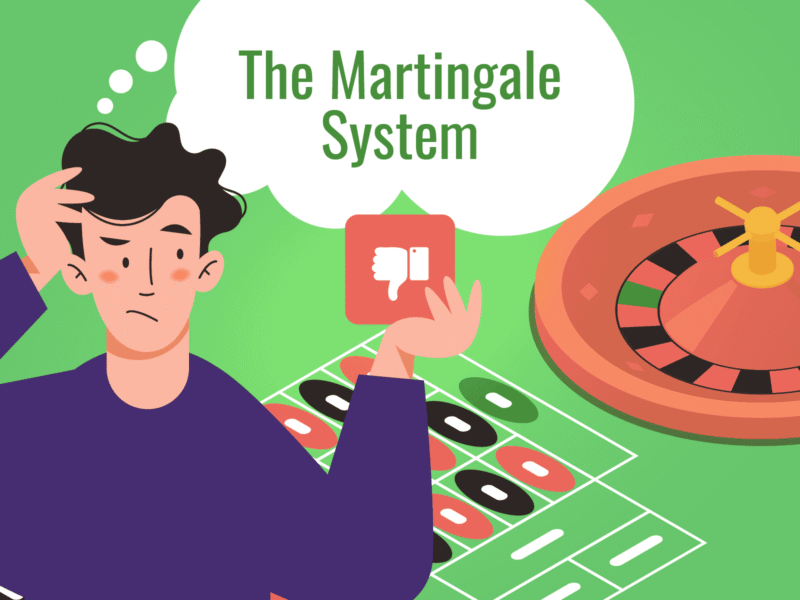
The Allure and Danger of Doubling Down
The Martingale System is one of gambling’s most controversial strategies—a high-risk, high-reward approach that tempts players with the promise of guaranteed wins. But does it really work?
In this comprehensive guide, we’ll break down:
✅ How the Martingale System actually works (with real-world examples)
✅ The mathematical truth behind its risks (spoiler: the house always wins)
✅ Where it can (and can’t) be used – roulette, blackjack, sports betting & more
✅ Psychological traps that make it addictive
✅ Safer alternatives for strategic betting
1. What Is the Martingale System?
🔹 The Basic Premise
- Start with a small base bet (e.g., $1 on “red” in roulette)
- Double your bet after every loss
- When you finally win, you recover all losses + a small profit
Example:
- Bet $1 on red → Lose (-$1)
- Bet $2 on red → Lose (-$3 total)
- Bet $4 on red → Win (+$4)
- Result: Recover $3 losses + $1 profit
2. The Math Behind the Martingale: Why It Fails
🔹 The Fatal Flaws
| Risk Factor | Why It Matters |
|---|---|
| Table Limits | Casinos cap max bets (often $500). A 9-loss streak could require a $512 bet! |
| Bankroll Limits | Few can afford infinite doubling. Just 7 losses = $127 down. |
| House Edge | Even “fair” bets (e.g., roulette red/black) have a 2.7% (EU) or 5.26% (US) house edge. |
Probability of a 7-Loss Streak in Roulette:
- European Roulette (1 zero): 1 in 142 spins
- American Roulette (2 zeros): 1 in 89 spins
💡 Key Insight: The longer you play, the more likely you are to hit a catastrophic losing streak.
3. Where the Martingale “Works” (And Where It Doesn’t)
✅ Best for Short-Term, Even-Money Bets
| Game | Odds | Why? | Risk Level |
|---|---|---|---|
| European Roulette | 48.6% (Red/Black) | Lower house edge (2.7%) | ⚠️ High |
| Baccarat (Banker) | 49.3% (1.06% edge) | Closest to 50/50 | ⚠️ Medium |
| Sports Betting | ~48-52% | Limited to specific bets | ❌ Very High |
❌ Worst for These Games
- American Roulette (5.26% edge)
- Slots (RTP 92-97%, no even-money bets)
- Blackjack (Strategy-dependent, not pure chance)
4. Psychological Traps of the Martingale
🔹 Why Our Brains Love It
- The Gambler’s Fallacy: “Red is due after 5 blacks!” (False!)
- Sunk Cost Fallacy: “I’ve lost $63… I HAVE to keep going.”
- Dopamine Rush: Doubling bets feels like “fighting back” against losses.
🎭 Real-Life Story:
“I used Martingale in Vegas—won $500 in 2 hours, then lost $3,000 in 10 minutes. The table limit stopped me from recovering.” – Mark, ex-gambler
5. Safer Alternatives to the Martingale
🔹 Modified Martingale (Less Risky)
- Fibonacci System: Bet sequence (1, 1, 2, 3, 5…) – slower growth
- D’Alembert System: Increase bets by 1 unit after losses
- Flat Betting: Stick to fixed bets (no chasing losses)
🔹 Smart Bankroll Management
- Never bet >1-2% of your bankroll per spin
- Set win/loss limits (e.g., quit after +$100 or -$200)
6. The Bottom Line: Should You Use It?
🚨 When to Avoid the Martingale
- You have a limited bankroll
- Playing high-house-edge games (e.g., American Roulette)
- Prone to chasing losses
✅ When It Might Work
- Short sessions (1-10 spins)
- European Roulette only
- Strict stop-loss discipline
💡 Pro Tip: Never use Martingale as a “get-rich-quick” scheme. At best, it’s a short-term tactic with extreme risks.
Final Verdict
The Martingale System is mathematically flawed but psychologically seductive. While it can produce small wins, the risk of catastrophic losses makes it a dangerous long-term strategy.
For sustainable gambling:
✔️ Use low-risk strategies (e.g., flat betting)
✔️ Set hard limits (time & money)
✔️ Accept that the house always has an edge
🎯 Ready to Play Smarter? Try Solitaire Cash!
If you love strategy but want lower-risk fun, check out Solitaire Cash at OnlineFortuneSlots.com!
🃏 Skill-Based Wins | 💰 Real Prizes | 🚀 No Martingale Madness!
Gamble responsibly. Terms apply. © OnlineFortuneSlots.com